
One agent can have ten properties. A hundred agents can have a thousand opportunities.
Imagine two estate agents. The first works alone. He has a careful portfolio, a professional presentation, his own clients and years of practice. Every day he meets the same limit: he can offer only the properties he can reach.
The second works just as independently, but he belongs to a professional network in which offices share listings, cooperate on transactions and connect their opportunities. Both can be equally able. Their possibilities are not equal.
That difference is the idea behind MLS — Multiple Listing Service. MLS is not only a property database. It is a way to connect supply, demand and professionals who would otherwise work apart. And it is, above all, proof that in the modern property trade the largest competitive advantage need not be the size of the office. It can be the quality of its cooperation.
What MLS is, and how it actually works
MLS, or Multiple Listing Service, is an organised system for sharing property listings among cooperating professionals. The principle is simple: the agent who represents the seller may, under agreed conditions, make the listing available to other authorised agents who can introduce a suitable buyer.
In the traditional model, offices often work in isolation. Each builds its own database, pays for advertising, gathers contacts and hunts for buyers. MLS widens that model. The property remains with its listing agent, but its commercial reach can grow through other professionals.
A working MLS stands on four pillars: shared listings; clear rules for presentation, contact and introduction; current information on price, photographs and status; and mutual trust — respect for client relationships, commercial agreements and professional standards. Not every property catalogue is an MLS. Not every programme that can export a listing automatically creates one. The decisive thing is not the technology. It is the cooperation the technology makes possible.
MLS, CRM and the property portal: three different tools
These three names are often used as if they were the same instrument. They are not. A CRM helps the agent run his own trade: clients, contacts, tasks, demand and the progress of a file. A property portal shows houses to the public. Its main job is to bring an enquirer to an advertised listing.
MLS connects property professionals and their opportunities under rules of cooperation. The three systems can support one another. Modern property technology therefore need not be built on only one of them. It can join the management of stock, the public presentation and a professional partner network in a single working environment.
That is the direction in which REALNYX is also developing.
Why cooperation matters more than the number of one's own advertisements
Every experienced agent knows the morning when a buyer is ready and the office has nothing that fits. The client has a budget, knows what he wants and is prepared to act. The agent has no house to show. In the traditional model the client may leave for a competitor. In a professional network the agent can search a partner listing and, under the agreed rules, take part in the transaction.
The same opening exists on the seller's side. An owner entrusts a house to one office. That office presents it, answers, arranges viewings and negotiates. Through cooperation it can also show the listing to other agents who already work with their own buyers. One agent represents the property. Another may introduce the buyer. Both create value.
Cooperation need not mean the loss of independence, of the client or of a commercial identity. It does have to stand on transparent conditions and mutual respect.
The real strength of MLS appears beyond the local market
The property market has long ceased to be only local. A buyer from Prague looks for an apartment in Spain. An investor from Germany compares opportunities in Portugal. A client from Scandinavia considers a second home in the Mediterranean. An agent who works only with his own local stock can serve that client only in a narrow way.
International cooperation opens another set of possibilities. A Czech agent can work with a Spanish office. The Spanish office can reach a foreign buyer. Both remain independent businesses. That, however, requires more than a shared list of houses. It requires language versions, clear information, correctly set permissions, respect for local law and transparent agreements on cooperation.
An international MLS model can therefore cross not only geographical borders, but also the barriers between national property markets.
Why the traditional model of the large networks is not the only path
Historically, large databases, shared systems and international contacts were often associated with the big property brands. Membership could give an agent access to technology, training, joint marketing and commercial opportunities. That model has advantages. It is not the only possible arrangement.
An independent agent need not change his name, enter a franchise or become part of a large office in order to use professional tools and cooperate with other specialists. Modern digital infrastructure can support more open partner models in which each office keeps its identity.
Independence and cooperation are not opposites. They can strengthen each other. That is one of the more important openings in the next shape of the property market.
REALNYX: technology, catalogue and cooperation in one ecosystem
REALNYX starts from the conviction that professional property tools should not be the privilege of the largest companies. The aim is to connect independent agents, offices and developers through a shared digital infrastructure, without asking them to surrender their brand or their commercial independence.
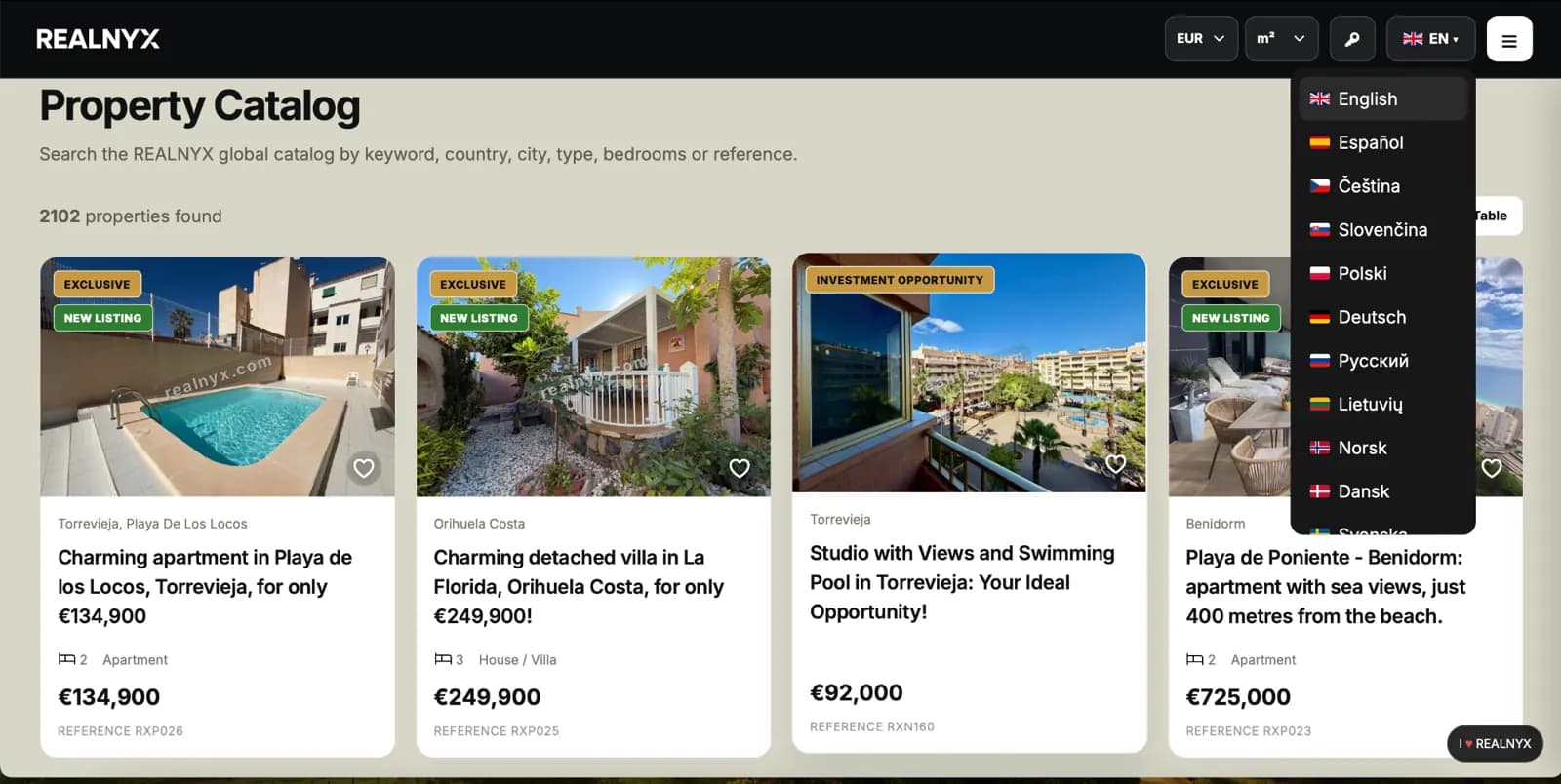
The REALNYX Global Catalog creates a common environment for presenting and searching properties from different places and markets. Offices can still use their own regional setting, present their portfolio and grow their name. The global catalogue does not replace the local office. It widens what the office can do. Sharing must respect rights in photographs and other materials, the conditions set by the owner of the listing, and the rules of the network.
REALNYX also develops tools for contractual documents, marketing materials and the daily management of work. The point is not to invent another isolated application. It is to reduce the number of tasks a professional must perform in separate systems. REALNYX takes its cue from the principles of MLS, but its conception includes a wider digital background for the property trade.
What MLS means for the seller
For the owner of a house the decisive question is not how many agents appear on the office's visiting cards. The question is whether the office can reach suitable buyers, present the property well and run the sale safely.
Cooperation through MLS can widen the circle of possible buyers without forcing the seller to deal with a crowd of offices himself. The house can be offered through more professional contacts, while the appointed agent still coordinates the sale. A wider reach may help find a buyer sooner, or create better conditions for a negotiation on price.
It is not an automatic guarantee. The result still depends on a correct valuation, the location, demand, the quality of the presentation and the state of the market. MLS does not replace an able agent. It gives an able agent more room.
What MLS means for the buyer
A buyer often does not want to speak to ten different offices, repeat his requirements and ask, each time, whether a particular listing is still available. Professional cooperation can simplify the whole process. The agent can help the client search beyond his own portfolio and, through partner relationships, coordinate the conversation with other offices.
That matters especially in a foreign purchase, where the buyer usually needs not only to find a house, but also to understand local conditions, documents and the course of the sale. A serious network must at the same time keep data current, protect personal information and draw a clear line of responsibility among its participants.
The greatest weakness of MLS is not technology. It is a lack of trust.
The best platform cannot create a successful cooperation if its participants do not respect common rules. Agents need to know who is responsible for the accuracy of a listing, who speaks to the seller, how the property may be presented, and how any commercial reward will be settled.
Without those rules, sharing can produce conflict instead of opportunity. A trustworthy system therefore has to support, above all: a clear right to publish and share listings; transparent rules of cooperation and reward; respect for client relationships; current and correct data; the protection of copyright and personal information; and the responsibility of each participant.
The quality of a partner network is not decided only by the number of registered agents. It is decided also by whether its members are willing, and able, to cooperate in fact.
The future of the property trade: less isolation, more opportunity
Digitisation has changed the way people look for houses. The trade itself still stands on relationships, trust, expertise and the ability to connect the right buyer with the right listing. The future therefore need not belong only to the platforms with the largest number of advertisements. It can belong to systems that join clean data, professional tools and real cooperation among independent property businesses.
MLS is one of the more important principles of that development. REALNYX builds its own vision on the same idea: an international environment in which property professionals can grow their businesses, share opportunities and still remain themselves.
The future of the market need not be about who owns the largest network of offices. It can be about who can best connect independent professionals. Discover the international property catalogue at Realnyx.com, and the professional tools and partner system of REALNYX.